Saturday, January 3, 2026

AfterShock

I'm happy to announce my new book, which is titled AfterShock, and which is a compilation of a sketchbook/journal that I kept in the year of recovery after Hurricane Helene devastated our part of the country, its epicenter passing over our little unincorporated town of Swannanoa.  The year was difficult, as you can imagine, but it changed not only the course of our rivers and our mountainous landscape; Helene also shed light on weaknesses of our infrastructure, of the siting of many of our buildings, and of our preparedness for natural disasters such as no electricity or water for many of us for very long periods of time.  

In spite of the derangement and dislocation of this time, there were joyous events, lovely plants, surprising beauties;  and these latter form a main focus of the book.  The practice of finding something beautiful every day in spite of collapsing buildings and overturned trees made this period a life-changing event that was not all bad.

If you're interested in owning a copy of the book or have any questions, comment below.  I have a limited number that I can sell to you;  you can also order a copy from Bookshop.org, the online sales arm of independent booksellers.


Saturday, September 3, 2022

Transition, Mushroom to Ants

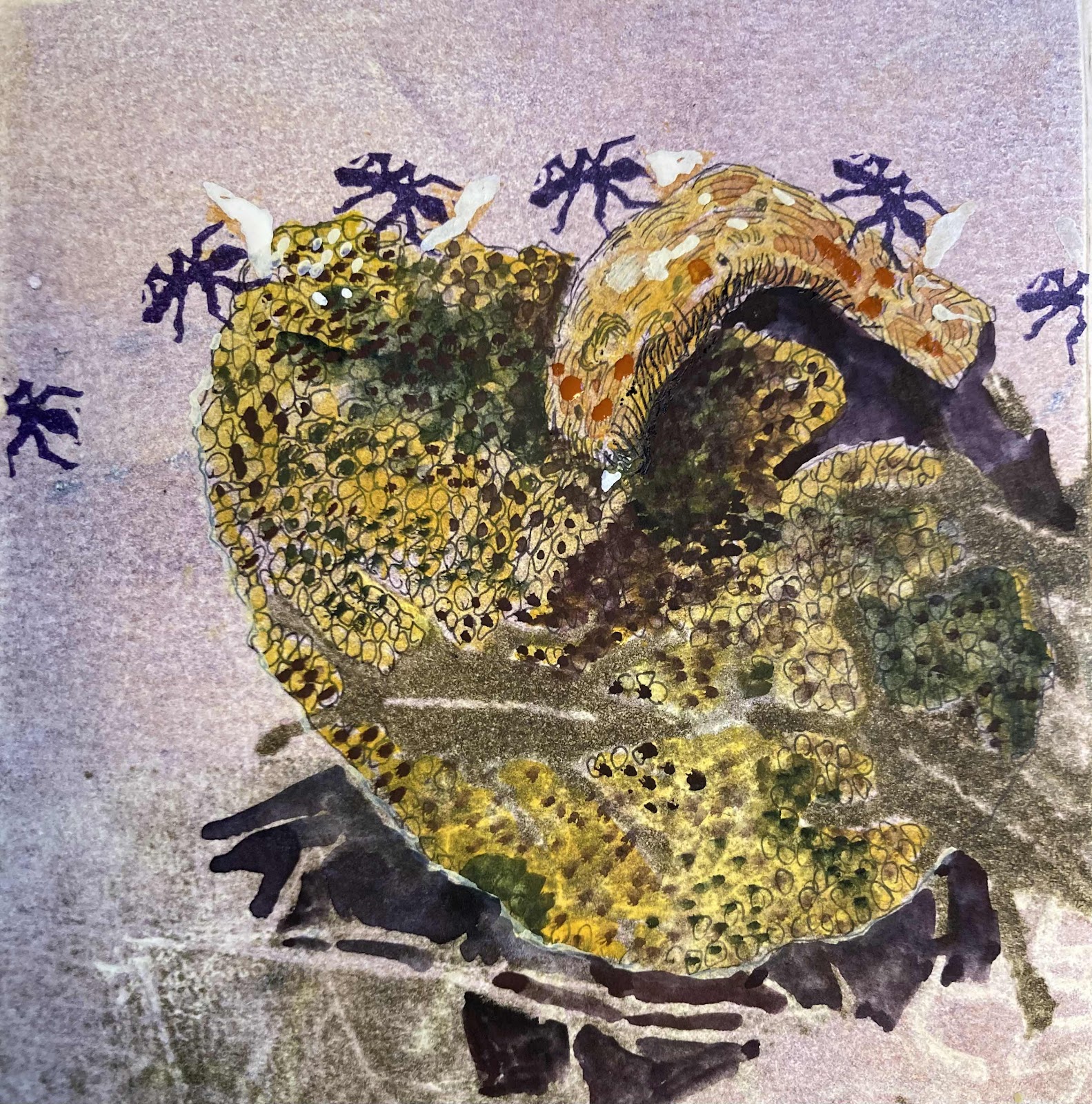
I’m back early from what I had intended to be my six weeks long break from posting.  Too much is going on to stay away.  The other day I was walking along one of the trails that had been filled with mushrooms of many kinds and colors a few days ago, and I realized that there are few traces left of these beauties now.  The forest is retreating into itself, and along with seed-making where flowers used to be, insects are quietly and efficiently moving parts of the retired plants and mushrooms to their own nests or into their very bodies.  

This single-file parade of large ants was removing sections of the spore tubes of a spent mushroom and marching off with the whitish pieces held like sails above their heads.  After a few feet they disappeared into a hole in the forest floor under some dry leaves. Food for the ants to store for their larvae, and at the same time, the forest floor was being cleared of debris.


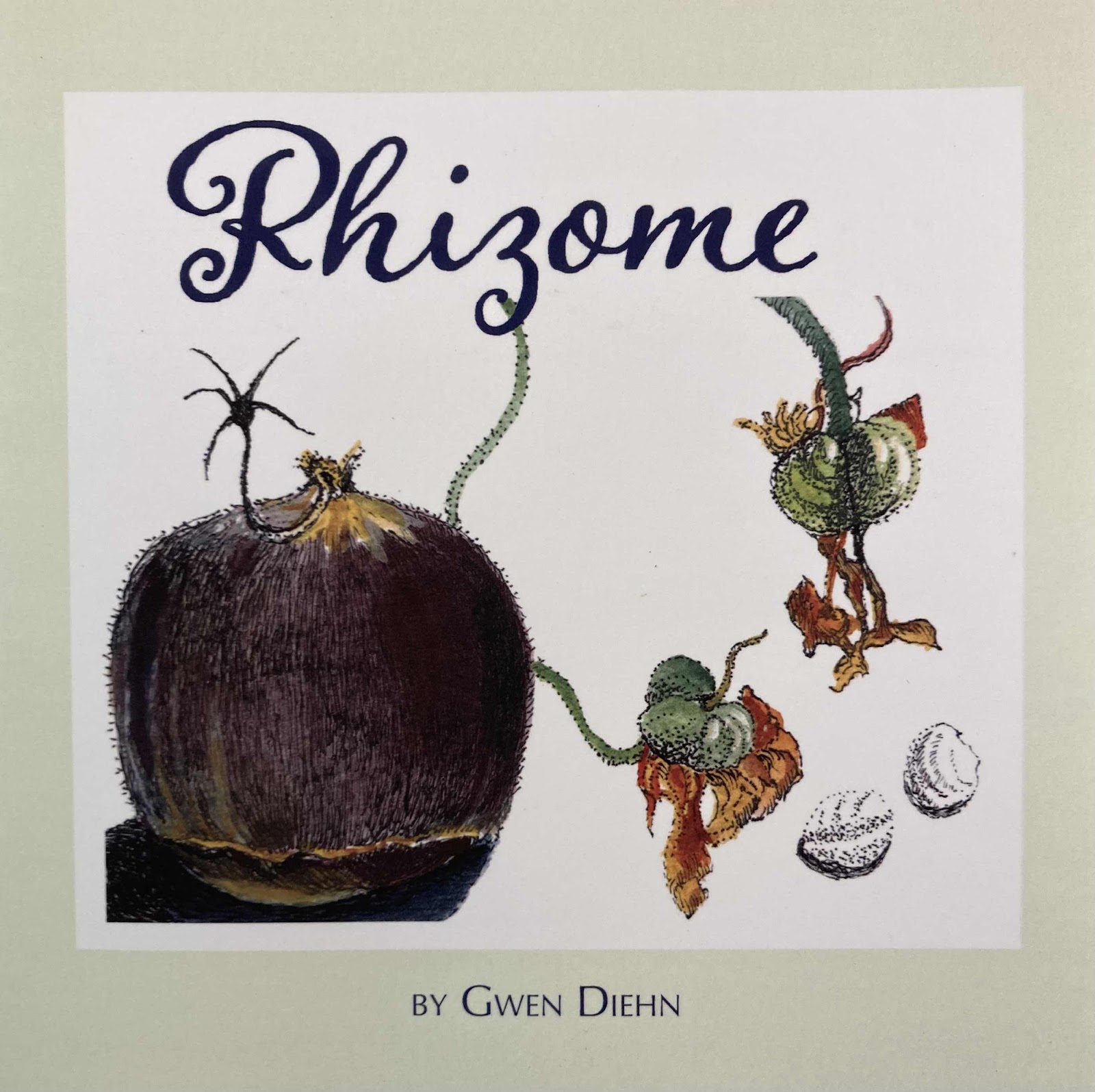
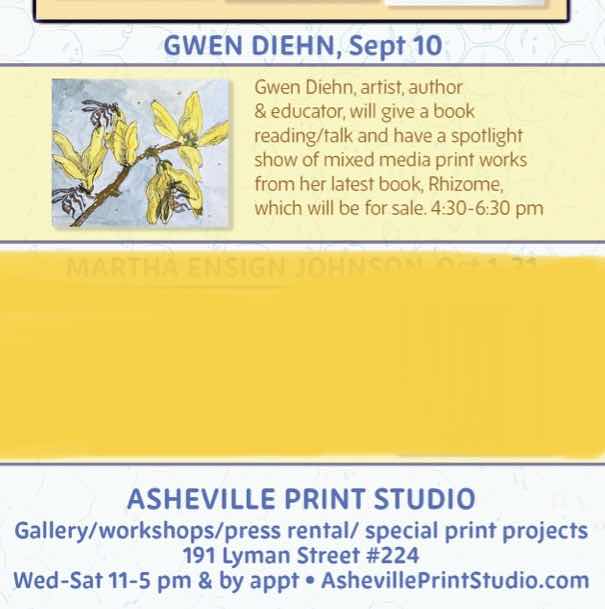
Another reason for coming out of posting sabbatical is that this Saturday is my reading and signing event at Asheville Print Studio, where the original sketches of all the illustrations in Rhizome will be on display and available for handling.  I’ll read a few short sections of the book, answer questions, and talk about how the book came to be.  There will also be copies of Rhizome on sale.


Hope to see you, local peeps!  To find APS, go down to Lyman Street in the River Arts District.  191 is one of the large brick buildings across from the biking and hiking trail along the river.  Riverview Station is the name on the building. The studio is on the second floor, and you can enter from the ground floor door  near the Tyger Tyger studio.  Go upstairs and turn right at the top of the stairs and left after you pass the restrooms.  First studio/gallery on the left.  There will be signs and arrows.  The reading starts at 4:30 pm.
#ashevilleprintstudio#naturesketching#riverarts

Wednesday, November 3, 2021

Echinacea as Magical Head Dress


Echinacea seed head worn, on the left, by a discarded Victorian china doll who faces a similar doll elevated by an elegant American chestnut burr, its velvety interior clasping the head. 

Echinacea (Family Asteraceae)  is native to North America and has been known to and used by Native people for centuries as a valuable medicine.  Long before antibiotics were discovered by western scientific medicine, echinacea was used to cure conditions ranging from colds and flu to toothaches to migraines to malaria and tumors.  Native people traditionally chewed and sucked on the root, which activated disease-fighting enzymes in saliva. 

For much more information about human-echinacea interactions as well as insect-bird-interactions, see https://en.wikipedia.org/wiki/Echinacea_laevigata

Saturday, October 30, 2021

Edibles


American chestnut from the surviving tree and nasturtium seeds forming from last week’s cut flowers.  The tassel at the top of the chestnut is on both American and Chinese chestnuts.  It’s actually the remains of the flower’s pistol, through which the pollen travels into the ovary during pollination.

The green nasturtium berries are also seed-bearing ovaries ( fruits), which grow in threes and then split apart and fall to the ground as the flower dries up.  These are the vitamin-packed caper-like seeds that early sailors snacked on to prevent scurvy.  I ate one of these green from the garden.  It was super peppery with a nasturtium undertone and a texture something like a raw green pea.  Will try soaking one in vinegar first.

I think the chestnut looks like a World Was 2 canteen in a brown velvet case.

Tuesday, October 26, 2021

Nasturtiums Seeding


Humans have loved nasturtiums for centuries for their beauty, of course, but also for their vitamin C as well as B 1, 2, and 3 and manganese, iron, phosphorus, and calcium.  Every part of this spicy little plant is edible.  Toss it in salads, float it on soups, even make little balls of soft goat cheese and walnuts and gently poke the balls into the center of the flowers for a light and healthy snack.  

The Incas taught the 15th century Spanish invaders to use  the pickled seeds as a source of vitamin C to ward off scurvy.  And if you fret about your eyesight, know that nasturtiums have more lutein than any other plant.  To make eye-strengthening snacks, drop green nasturtium seeds in vinegar for a few days, then eat them like you would capers.

Even after the plants have seeded and return to the soil, they secrete an essence into the soil, which is absorbed bu other plants, and which helps them resist attacks by pests and diseases.  And as if that weren’t enough, nasturtium nectar is nutritious for the bees and other insects that pollinate the plants.

Wednesday, August 19, 2020

Ways of Wearing a Mask


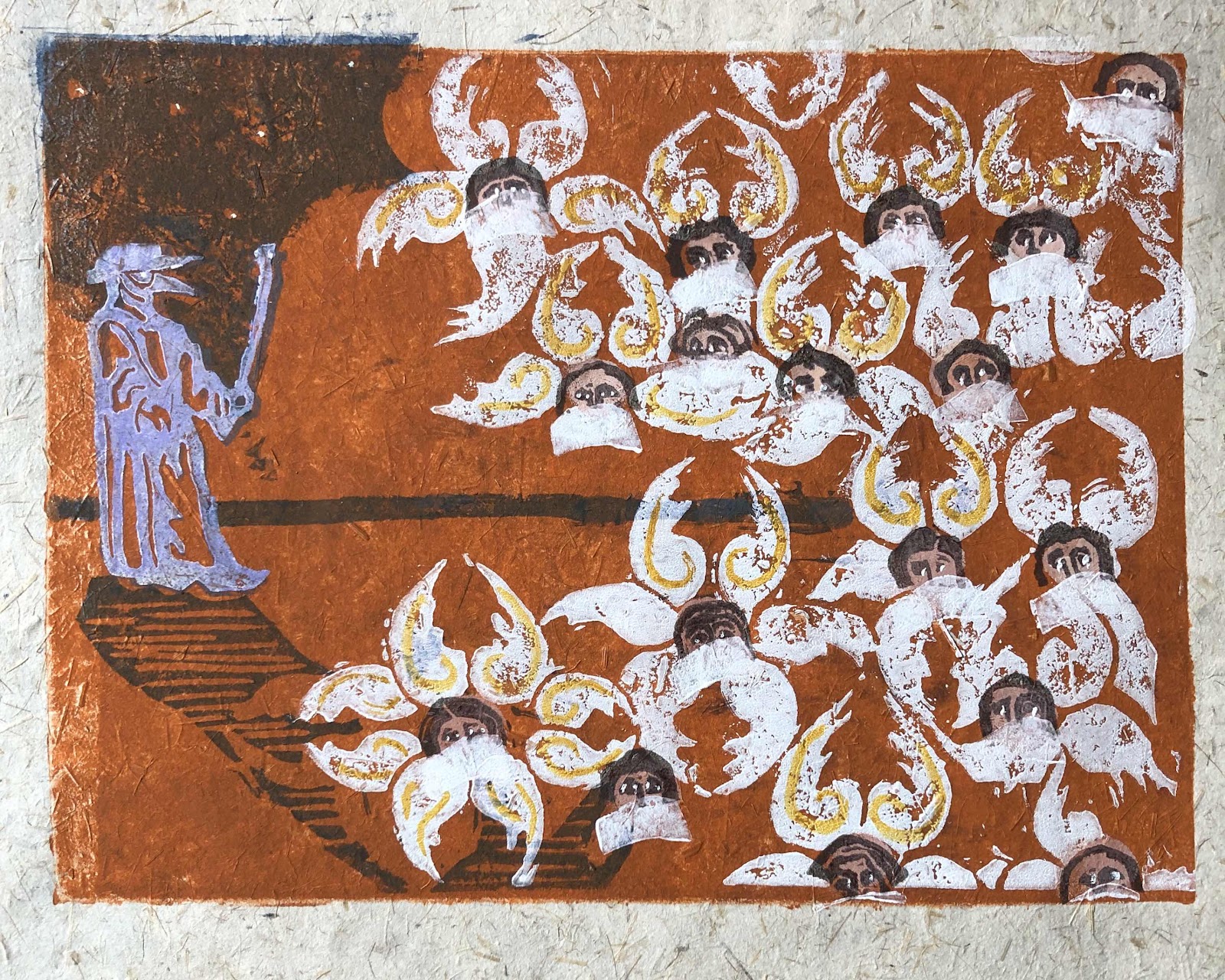
This is the third print in my series of three fund-raising prints.  Based on a sketch from my daytimer sketchbook, this one is 6 x 8” , a relief print with watercolor and gouache printed on various handmade papers as well as kozo.  Varied edition of 20, title Ways of Wearing a Mask.

Are We There Yet?


This is the second of the series of three prints that I made and sold to help raise money for the Navaho Covid-19 relief effort.  This is a relief print with watercolor and gouache added.  6 x 8” edition 20 printed on kozo paper, title  Are We There Yet?”

Wednesday, May 13, 2020

The Eyes

These are two proofs from a multi-block relief print based on the drawing that I did in my daytimer last week.  Dimensions are 6.75x9”,  and papers are handmade from cotton denim (bottom) and corn leaves, straw, abaca, and hemp (top).  The print is the first in a series of three that I did to help raise money for the Navaho-Hopi Covid-19 relief effort.  Title: Eyes.


Sunday, May 3, 2020

Seven Day Challenge Day 7


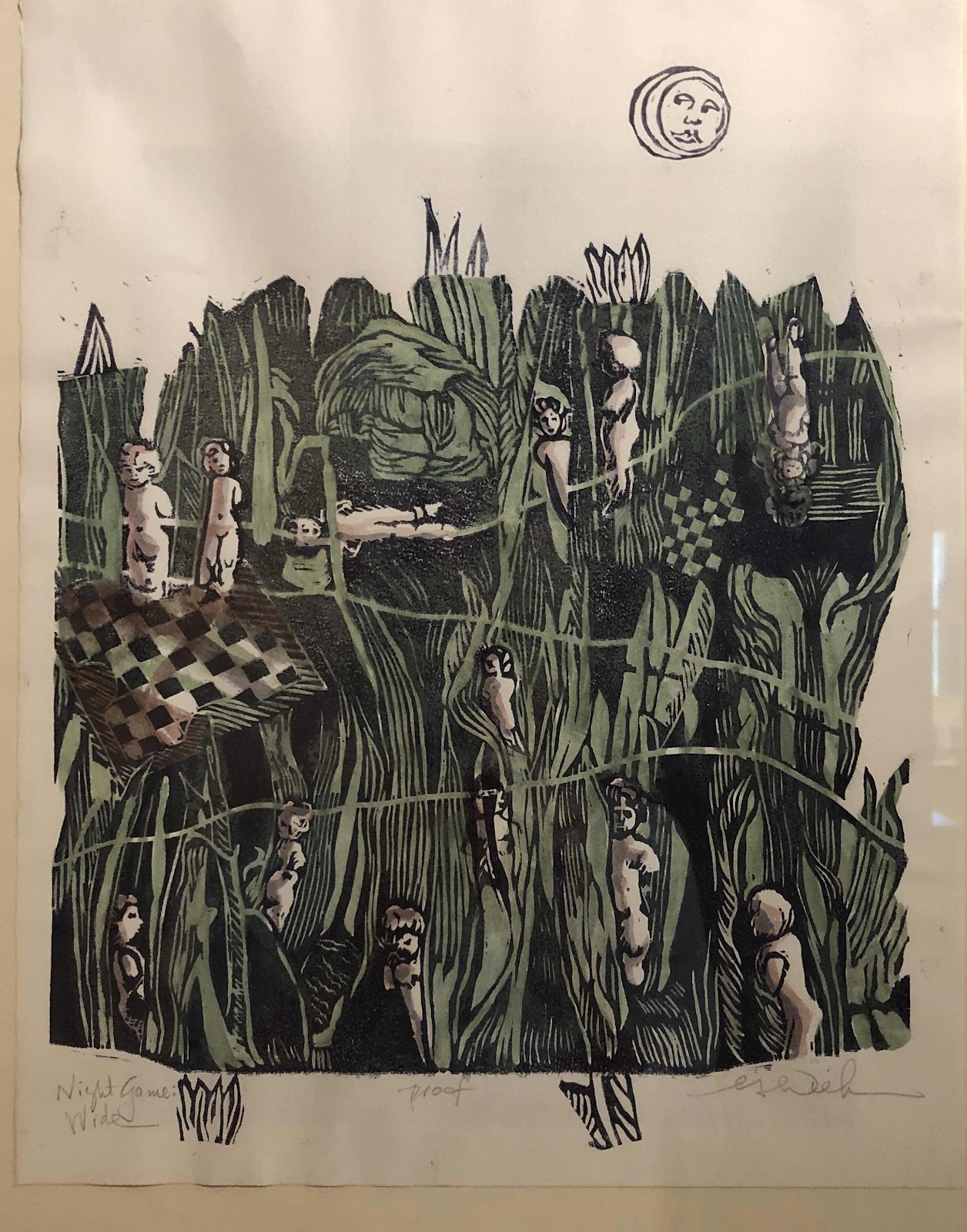
Night Games/Wide woodcut print with small rubber eraser prints , watercolor 10 x 12”  And below book version of this print.


Seven Day Challenge Day 6


 Helena Kottanner’s Memoire  8 x 12 x 1/2” limp vellum binding with Twinrocker paper, vellum straps, Cartiera Magnani Velota  paper, 56 blocks carved out of poplar, printed on an antique Vandercook letterpress, hand-touched with watercolor;  photopolymer text plates by Brandon Mies; edition 125.  Published with a Library Fellows grant from the National Museum of Women in the Arts. Manuscript by Helene Kottanner.  Translated from Middle High German to English by Hildegard Stalzer Bomer with a Readers Digest Teacher-Scholar grant.

Seven Day Challenge Day 5


Faubourg Nam Main Bon Dieu  (with Laura Ladendorf)  Large ( 22 x 30”) woodcut with numerous small rubber eraser material cuts, watercolor, and copier transfer underlayer  
Done in celebration of growing up in New Orleans near Bayou St. John and the race track.

Saturday, May 2, 2020

Seven Day Challenge Day 4


This little house is called Temporary Shelter.  It ‘s one of the first 3-D pieces I did in the late 90s/early 2000s.  


It’s 15” high x 7” wide x 7” deep, made of  bookbinder’s board covered with paper and lined with pen and ink and watercolor drawings.

Friday, May 1, 2020

Seven Day Challenge, Day Three


Monotypes are a kind of painted print.  On a sunny morning I set up this informal still life and rolled out oil ink onto a zinc plate using a brayer.  After a couple of hours of rag wiping, painting, texture impressing and more brayering, I lay the plate face up on my press with a piece of damp etching paper on it and felt blankets on top of plate and paper.  I cranked the whole sandwich through the press,  and out came this print.  I did the second one the same way.

This third print is a monotype done with reference to a photo of a falling-down house on my friend’s property.


Thursday, April 30, 2020

Seven Day Challenge


Both of these are of my friend J, who was among the many friends and family members who would put up with modeling for me as I turned into sort of a roving court reporter, recording whatever the people around me were doing.  Both drawings are fairly large graphite and wash.


Wednesday, April 29, 2020

Seven Day Challenge


This print is from the seventies when I was an undergrad art student doing many figure studies and learning how to make relief prints.  It’s around 13 x 15 inches and printed on Japanese hosho paper. 
Test

Thursday, December 20, 2018

In-Process

A friend wrote and asked me about our process on this piece.   First my friend and I immersed ourselves in research about the history and pre-history of this little slackwater bayou we both used to live near.  Then we got together every few weeks and began brainstorming and sketching layouts.  We also started carving eraser blocks of early flora and fauna from an 18th century book we managed to find about this very bayou!  Eventually I sawed up a large piece of birch plywood for the background print.  We spent a couple of afternoons printing the sawn block.  Then we would sit together and work side by side on two of the proofs using our collection of stamps and dome water soluble crayons and watercolors.  We’re still at that stage, going very slowly on our two proofs.  Here’s mine propped up still in process in my kitchen.


Sunday, November 25, 2018

Robin


Huddled in a corner of our porch this afternoon this robin holding perfectly still.