Monday, May 9, 2016

Dissection

I've had this little dried up bud or immature cone on my drawing table for about a month.  I picked it up in the middle of the street, near a large magnolia tree; so I have an idea it might be a bud that fell off and never developed.  (7114). It's dry and crackly, about the size of a large palmetto bug/roach and similar in color.  These drawings show the progress of the dissection.

My first experience of botanical drawing was in third grade when Sister Sheila, my teacher, asked me to stay after school every day for a week and copy some botanical drawings that she had borrowed from someone.  She was unable to draw well enough to copy them so she asked me to do it for her, an assignment for a class she was taking.  I enjoyed drawing them very much, especially the ones that were of microscopic things.   

Sunday, May 8, 2016

The End of the Ramp Festival

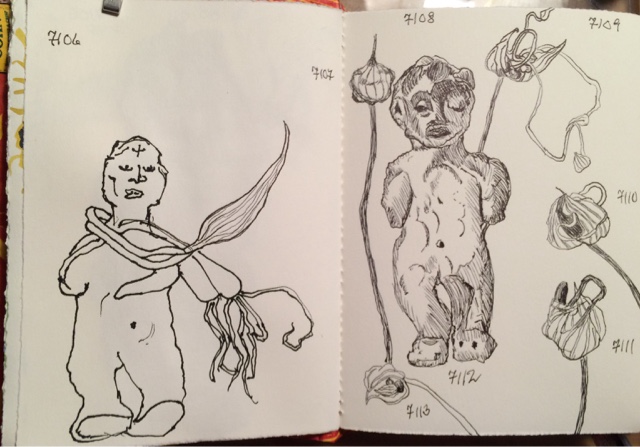
Our friends who know about and actually grow ramps came over today.  We took a 4 1/2 mile hike then came home and cooked a feast that included the remaining ramps, which I quickly sketched in various settings before we chopped them up.
The lantern-like festival torches are wild chive buds that I found while we were tromping through the midday heat in the woods.

Saturday, May 7, 2016

Outdoor Wedding vs Field Trip

There was a sweet wedding at the celebration place across from the east river trail late this afternoon.  I crouched down to get a close look at some chives while the string quartet was playing some Pachelbel;  the soft rose scent was everywhere on the breeze.  Suddenly a stampede of around 15 middle grade children and three teachers or camp leaders came galloping along the trail and landed on a rocky beach exactly across from the wedding.  The happy shrieks of kids playing in the water made an interesting addition to the music, which grew louder and faster.  

Friday, May 6, 2016

Ramp Omelet!

The roses are blooming in the woods but no honeysuckle yet.  Maybe next week.  Meanwhile I chopped up a few of the ramps and put them in a pan with two chopped up slices of bacon.  Then I added three beaten eggs and sprinkled cut up kale from the garden over the top.  I flipped one half of the circle of eggs over to make a ramp-bacon-kale omelet.  It was delicious but we could barely taste the ramps.  Tomorrow I'll be more bold with the ramps!  On the right is the Ramp King.

Thursday, May 5, 2016

Ramps!

I've heard about ramps ever since we moved to Asheville in the mid-80s but today was the first time I've ever actually seen them.  Whole Foods has a bin of local ramps!  I grabbed a bunch of them to paint, and tomorrow morning I'm going to scramble some eggs with bacon and ramps.  They have lily-like leaves, which makes sense since they're in the amaryllis family.
I have a friend who finds them in some woods nearby but won't divulge the exact location.  Ramp festivals are popular in towns in the areas where they grow.  One interesting fact I found is that the city of Chicago was named for a dense patch of ramps that grew in the marshy land near Lake Michigon.  The native people called them shikaakwa.
The Ramp Festival at Cosby, TN, chooses a Maid of Ramps.

Tuesday, May 3, 2016

Monday, May 2, 2016

Much Info on the Lotus-like Plant!

First a quick couple of sketches from yesterday-- people eating at Thai Orchid:

Well, not the cows, but the two above and on the left.  The cows I drew today from inside their pasture.  I found out that Bellpepper is actually the little milk cow's name, and the big wooly sheep are nameless( at least according to the farm student   that I talked to).
Now press your nose close to this page or find your magnifying glasses, because I crammed eight drawings (life sized) and all the info I could find on this page.
This pod is the same as 7044 from 04.30 only drawn much more carefully from life while I was squatting down a few inches from the plant so I could see all the details of the pod.  The rest of these I drew from pictures on my phone.  The real plants are growing in a raised bed under a shade (drawings 7062 and 7064). 

I learned that the plant is a Jeffersonia Berberdaceae, commonly known as ground squirrel, twin leaf, helmet pod, rheumatism root, or yellow root.  It is so rare that people are asked to not harvest it.  Students at the college are growing it along with other native plants and medicinals. 

The flowers are white, with eight petals and yellow center parts. Inside the pod (which looks like a knight's helmet when it opens along a dehiscent line) contains a nut - like seed.  All parts of the plant are useful , especially the roots.  It is powerful medicine (read at the bottom of the page) and is poison in the wrong hands!