Saturday, February 8, 2014
School Cafeteria Lunch and a Puzzler
Even though I mostly remember bringing my lunch, there definitely were days when I had to eat in the cafeteria. This was a much more fraught kind of lunch, as we were at the complete mercy of the cafeteria, with no choices about what we ate or how much. Of course the ever-present garbage-can-guard nun was there to scrutinize the tray before you slapped it upside down against the edge of the can and to send you back if you had left food uneaten.
Drawing 1801 is of nice Miss Cookie, our main cafeteria lady, wearing her hair net. She and all the other ladies always wore nets over their permed hair and white aprons over their dresses. Her main serving utensil was a large scoop (drawing 1804) with which every manner of food was dispatched in tennis ball- sized scoops. Down at the bottom on the left is my friend, the garbage can; toward the middle is a white milk carton (no chocolate on regular days, only with donuts on First Fridays).
Drawing 1806 is of one of those tiny cardboard tubs of ice cream and its flat wooden paddle. The tub held about two mouthfuls of ice cream. You pried the flat lid up by pulling on a little tab. Occasionally there were no wooden spoons, and we then bent the circular lid in half and used it to scoop the ice cream out. Ice cream came in chocolate (the best), vanilla (okay) , and the dreaded strawberry/pink, which I really disliked. Ice cream was a random treat. Once someone came into our classroom at the end of the day and doled out a carton to each of us for being good or something. It was served as lunch dessert on special pre-holidays, the last day of school before Thanksgiving, for example.
Lunch was served in divided rectangular tray-plates, a stack of which you can see at the top, still damp and hot from the dish machine. Beneath the stack is a fully-loaded lunch tray. See if you can guess what's in each compartment. The answers will be written in code at the bottom of this post.
Drawings 1809 and 1810 show the difference in viscosity between real pudding on the left (with its intriguing and delicious skin on top) and the thin, watery, fake (and probably instant) pudding that was served at school.
answer to puzzler (clockwise from top left of tray): daerb dna rettub, etalocohc dna allinav gniddup,
llabtaem dna der yvarg no ecir, gnilc hcaep
Thursday, February 6, 2014
School Lunch, Homemade Variety
Wednesday, February 5, 2014
And Stones in Our Cakes
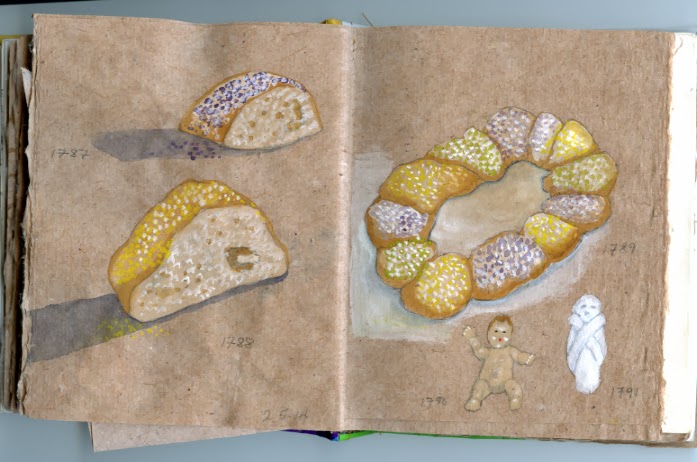
My brother Richard wrote last night saying that he didn't have any memories of donuts at school on First Fridays, but that he remembered King Cakes. So this post is for him. He mentioned the authentic king cakes, the ones that came from McKenzie's bakery, and he is absolutely right. There are many pretenders, but most of them are a case of what my mother would have called gilding the lily-- ruining a good thing by overdoing it. I was cautiously excited when I saw a boxed cake at our Whole Foods a couple of years ago that had a label that said King Cake. But the cake turned out to be heavily frosted with gloppy white sugar frosting and with sprinkles scattered over it, far too rich to eat as often as we ate king cake, which was for some of us almost daily during the season between Twelfth Night and Mardi Gras.
The real New Orleans king cake was a simple brioche pastry, more like a breakfast sweet roll than a cake. It was always made in an oval, flattish on top, with sections that were sprinkled with gritty granulated sugar that had been dyed green, gold, and purple, the Mardi Gras colors. No frosting, no maraschino cherries, no sprinkles, no little plastic crown stuck into it announcing what it was. It came in a plain clear plastic bag with a twist tie.
Inside every king cake was buried a babyjesus, and it was exciting to get the baby! Sometimes if you got the baby at a party you had to choose a partner (your boyfriend or girlfriend) to be your king or queen, and the two of you had to host the next week's party. In families, the person who got the baby was envied by all. On the left are two slices of cut cake. It was considered highly unethical to peek at the underside of the cake before choosing your section. Often the baby had sunk to the bottom and could be clearly seen on the bottom of the cake. You had to make a blind choice. Can you find the baby's arm poking out of one of these two pieces of cake?
The two babies on the right represent two different varieties. Our parents had told us that During The War king cakes had had pecans or almonds in them instead of babies. This substitution was somehow connected to wartime austerity, but by the fifties, plasticky rubber babies were coming into fashion, and the older china babies were somewhat rare. It was thought that it was too easy to break a tooth if you chomped down on a china doll, so everyone chewed a little carefully until the doll surfaced. One year I swallowed a china babyjesus a few minutes after finding it in my piece of cake. I was around five or six years old and had been chewing on the doll to clean all the cake off of it while I waited to leave for a program at school. When I choked my dad grabbed me by the feet and held me upside down and shook me until the babyjesus flew out.
Tuesday, February 4, 2014
With Stones in Our Stomachs
My brother Bob sometimes writes to me and asks me childhood trivia questions. Sometimes these are trick questions, the answers for which I can earn points; but other times he really wants to know something that he thinks I, being 18 months older and vastly more knowledgeable, will know. Tonight he wanted to know how the Catholic school that we went to handled breakfast on First Fridays. A little background: in Catholic school in the 50s we went to Mass and communion on the first Friday of every month of the school year, the performance of this devotional being a guarantee that when we died, we would go to heaven on the first Saturday after our death. In order to go to communion, however, we needed to fast from all food and water from midnight on Thursday night. The result was several hundred children needing food at 9:30 on Friday morning at a time when our cafeteria ladies were busily whacking open boxes of frozen fish sticks and french fries for lunch.
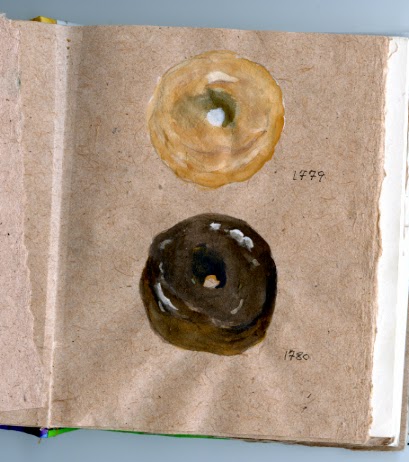
So the solution, and the answer to Bob's question, is that they sold us donuts and milk from the candy counter, around the corner from the place where lunches came out. We were crazed and also faint with hunger, the donuts were cheap, and I for one bought as many as I could carry. Here, drawn from memory, were the kinds of donuts we bought: at the top is a Plain, which was a vanilla glazed fried donut, not to be confused with a frosted donut. At the bottom, my favorite, is a Chocolate, which was the deep brown--almost purplish black-- version of the Plain, with little translucent flakes of fried sugar crusting the surface in a very pleasing way.
Bob remembers powdered sugar donuts. I don't think they were sold at our school, but I'm including one here for him. Below the Powdered Sugar is a Chocolate Frosted, also a cake donut, also not sold at our school as far as I remember. But on the right are my other two favorites: at the top a Plain Twist, and below it a Chocolate Twist. These were the best. I would bite the skinny tip first and then wolf my way down the tender inside doughy coils, leaving the fat base for last.
At the bottom of the page are two cartons of milk, the only beverage choice, gloppy sweet chocolate or nasty, milk-tasting white. Bob and I both despised milk, still do. We share the memory of devoting hours of our time to picking flecks of cream off the surface of our milk in those days before homogenization. We both believed that if we drank White through a straw it didn't taste like milk, nor did it do that dreadful mouth-coating thing, Our mother explained to us that since you couldn't smell the milk when you drank it through a straw out of a carton, you wouldn't be able to taste it. That was the only way I was ever able to drink the stuff. As often as possible I dumped my mandatory carton in the garbage.
I could easily put away four of those donuts. The print (from a carved rubber eraser) above is of me walking to my classroom with four donuts sitting like stones in my stomach and the sugar starting to kick in, just in time for three hours of uninterrupted desk-sitting.
Monday, February 3, 2014
Early Spring?
As unlikely as it seems after last week's below zero mornings, today we found hyacinths and daffodils as well as daylilies peeking out from under some dead leaves in the garden. Jesse plopped down on a paving stone in the afternoon sun and watched the neighborhood. He leaned on his elbow and shifted occasionally. I drew him twice, then drew some of the little green bulb bloom shoots. Then J came with me to walk along the hills behind the house and survey the fields, which have been bleached to lightest yellow ochre. The hedgerows are dark, almost black, and the cows are browsing for food in the straw-like grass and corn stubble. There's that one dark tree-- I think it's a giant holly tree-- sitting in the middle of Dogwood across from the sheep. I can see it from the hills behind our house if I walk a bit downhill and to the left. Love those criss- cross hedgerow patterns!
Sunday, February 2, 2014
Caput Mortuum for First Days of Spring
Whenever there's a convergence of festivals from various traditions, you can be sure the festivals share a common root, although the present-day celebrations may be far from similar to each other. At the beginning of February there's the sweet and welcome convergence of Imbolc, which was considered the beginning of spring in Medieval Ireland, among other places, on February 1; Groundhog Day and Candlemas on the second; and on the third, St. Blaise and the blessing of throats. Imbolc falls at the point equidistant between the short day of winter solstice and the equal-light-equal-dark day of the spring equinox, a turning of the dark winter tide toward the light of spring. It was a day on which rituals were performed to ensure a good harvest. Candlemas was celebrated by Early Christians as a feast of light, a time when new candles were blessed for the coming year. It was also tied in with the feast of the Purification of Mary, 40 days after the birth of Jesus, when Mary was allowed to re-enter the temple after childbirth following water rituals, a Jewish requirement. Both light and the goddess returning? You can be sure these Christian feasts had roots in much older celebrations.
Groundhog Day began in the 1500s in England at the time of year when farmers were eager to get going with those traditional Medieval February tasks, and they began to check on hibernating animals. They knew that the animals were able to determine when it was safe to wake up from hibernation. In England the hedge hog was the animal most handy for observation. In America, where there were no hedge hogs, immigrants from England used ground hogs as weather predictors.
In our Catholic neighborhood in New Orleans, St. Blaise Day was a nice, if slightly odd, break in the tedium of winter. We went to Mass during the school day and at one point, we marched up to the front og church where a robed priest, holding two crossed candles (unlit), pressed the crossing gently to our throats and blessed them to ensure that we would not get sore throats. This was auspicious timing, as Mardi Gras was just around the corner and we would be screaming ourselves hoarse at every parade: "Hey Mister!! Throw me something!!!!" The story was that St. Blaise had been a bishop who had saved a boy's life by blessing him while he was choking on a fish bone.
I celebrated Imbolc-Groundhog Day by taking a caput mortuum walk in the woods. Caput mortuum is a deep reddish-purplish-brownish pigment that comes from iron oxide -filled ochres. I've found it not far from here in the banks of a lake that had been lowered when a dam had been opened. The name caput mortuum means "head [and the expression caput! implies chopping off of a head]" "of death", and Goethe is said to have remarked that this color signals the death of death-- the end of winter. It is the first warm color to emerge in the earliest spring. Goethe said it was the color of red maple blossoms, and it is. I found many examples of it today: the raspberry and blackberry canes are now turning bright caput mortuum, thanks to the rising sap; tiny buds on the apple trees are that color as they emerge; wild rose stems are blushing with c.m., as are the small leaves that are beginning to come out.
Later I walked around our yard and found even more examples, all labeled on the left of the bottom page. On the right of this page is a copy of a Medieval manuscript painting, which shows the rural tasks of February-- digging, plowing, sowing. Even though Punxatawney Phil is predicting more winter this year, the plants around here are not so sure.
Saturday, February 1, 2014
More Waiting People
On the left is a bonus that I'm not counting as a drawing, from last night, the recipe for the stir fry we had at Ichiban, really good. Tonight I found myself at 7:15 in a restaurant, not a drawing done all day. So there was nothing to do except draw more people. I was happy to notice that there were several people waiting, so I continued yesterday's theme of People Waiting. The first woman was waiting for her take-out, standing at a counter watching the waitress bag it up. The woman on the right was the hostess, waiting behind a counter for more people to arrive. It was a really slow night.
We were the only customers after the take-out woman left. A cook came out from the kitchen and stood at the counter reading something while he waited for something else to need cooking. The waitress stood behind the counter and stared into space, glancing over toward us from time to time, waiting for us to need our water glasses topped off. Then the cook ambled over to a table and sat down and looked out the front window.
The hostess came and sat at the table with the cook and fiddled around with her phone while she waited. It isn't a bad restaurant, but it has a feeling of doom about it. It's buried in a strip mall along a very busy road, hard to see for all the traffic and situated very badly for people trying to turn in to it from the west, as we were. But it was a good place for drawing all those waiting people.
Subscribe to:
Posts (Atom)